📊 报告来源:行业研究报告
导语
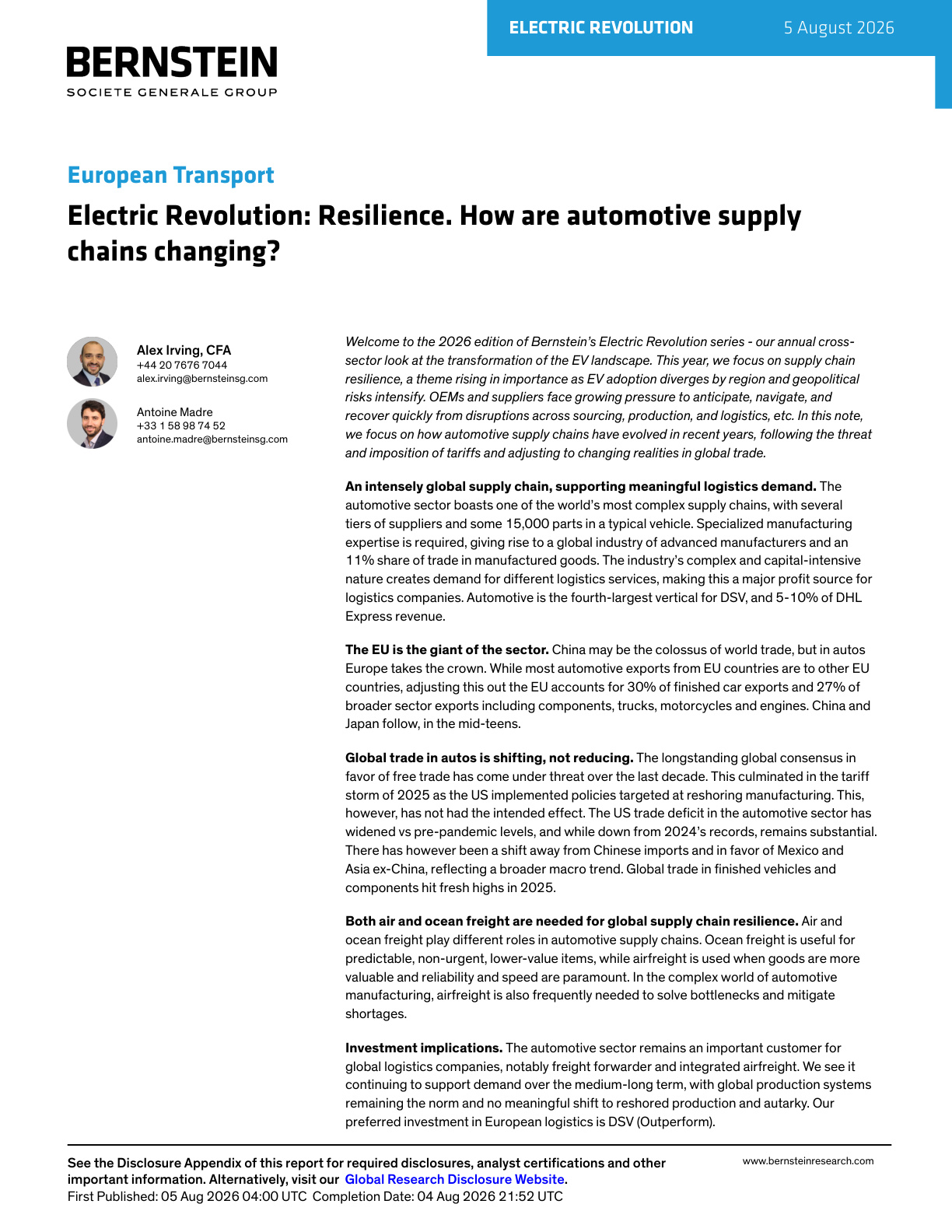
ELECTRIC REVOLUTION 5 August 2026 European Transport Electric Revolution: Resilience. How are automotive supply chains changing? Alex Irving, CFA +44 20 7676 7044 alex.irving@bernsteinsg.com Antoine Madre +33 1 58 98 74 52 antoine.madre@bernsteinsg.com Welcome to the 2026 edition of Bernstein’s Elec…
核心发现
- ELECTRIC REVOLUTION 5 August 2026 European Transport Electric Revolution: Resilience
- The automotive sector boasts one of the world’s most complex supply chains, with several tiers of suppliers and some 15,000 parts in a typical vehicle
- Specialized manufacturing expertise is required, giving rise to a global industry of advanced manufacturers and an 11% share of trade in manufactured goods
- Automotive is the fourth-largest vertical for DSV, and 5-10% of DHL Express revenue
- This culminated in the tariff storm of 2025 as the US implemented policies targeted at reshoring manufacturing
深度解读
ELECTRIC REVOLUTION 5 August 2026 European Transport Electric Revolution: Resilience. How are automotive supply chains changing? Alex Irving, CFA +44 20 7676 7044 alex.irving@bernsteinsg.com Antoine Madre +33 1 58 98 74 52 antoine.madre@bernsteinsg.com Welcome to the 2026 edition of Bernstein’s Electric Revolution series – our annual cross- sector look at the transformation of the EV landscape. This year, we focus on supply chain resilience, a theme rising in importance as EV adoption diverges by region and geopolitical risks intensify. OEMs and suppliers face growing pressure to anticipate, navigate, and recover quickly from disruptions across sourcing, production, and logistics, etc. In this note, we focus on how automotive supply chains have evolved in recent years, following the threat and imposition of tariffs and adjusting to changing realities in global trade. An intensely global supply chain, supporting meaningful logistics demand. The automotive sector boasts one of the world’s most complex supply chains, with several tiers of suppliers and some 15,000 parts in a typical vehicle. Specialized manufacturing expertise is required, giving rise to a global industry of advanced manufacturers and an 11% share of trade in manufactured goods. The industry’s complex and capital-intensive nature creates demand for different logistics services, making this a major profit source for logistics companies. Automotive is the fourth-largest vertical for DSV, and 5-10% of DHL Express revenue. The EU is the giant of the sector. China may be the colossus of world trade, but in autos Europe takes the crown. While most automotive exports from EU countries are to other EU countries, adjusting this out the EU accounts for 30% of finished car exports and 27% of broader sector exports including components, trucks, motorcycles and engines. China and Japan follow, in the mid-teens. Global trade in autos is shifting, not reducing. The longstanding global consensus in favor of free trade
一句话总结
ELECTRIC REVOLUTION 5 August 2026 European Transport Electric Revolution: Resilience. How are automotive supply chains changing? Alex Irving, CFA +44 20 7676 7044 alex.irving@bernsteinsg.com Antoine M…